Language, Education and Citizenship in Japan by Genaro Castro-Vázquez
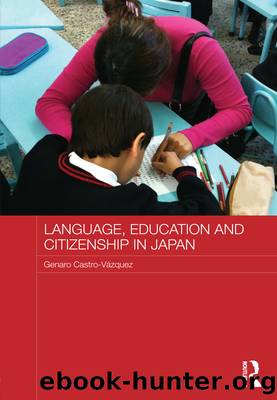
Author:Genaro Castro-Vázquez [Castro-Vázquez, Genaro]
Language: eng
Format: epub
Tags: Social Science, Ethnic Studies, General
ISBN: 9780415501033
Google: w7i-p0wMmTcC
Publisher: Routledge
Published: 2013-01-15T04:43:42+00:00
Interviewer: Why? Without him the school can't work?
Interviewee: I don't think so but he leads us. Teachers are like mothers who nurture and see minor details in the education of children. I think women are better at practical stuff. Most primary school teachers are women and those in charge of first and second grades are unmistakably women.
From a vulture's eye view (Whitty 1997) and within the grid of the Orientalist narrative, the links between motherhood and ethnic background to â explainâ children's academic achievement are not particular to the interviewed education personnel. Amy Chua's (2011) book Battle Hymn of the Tiger Mother has triggered academic and mass media controversies with its suggestion that results in international academic evaluations are strongly influenced by the support Asian students get from their mothers, in the understanding that âAsian mothers, more comfortable than Westerners with the idea of meritocracy, drive their children hardâ (The Economist 2011c). In this light, the next chapter explores how schooling, ethnicity and gender are entangled in the lives of the three foreign households.
Conclusion
School participant observation together with the transcripts of interviews with a group of Japanese education personnel show how the situation of the so-called newcomer children has barely changed vis-Ã -vis the circumstances of oldcomers. The option for foreign students is either to attend regular schools and endure relentless assimilation to âpassâ as Japanese or to attend foreign schools at the risk of deepening their social marginalization.
The narratives indicate that discourses on multiculturalism and internationalization have permeated official Japanese education initiatives for more than two decades. However, the reality at public schools seems to be monocultural. Despite officials and teachers trying to help foreign students, in reality, the situation seems to be beyond their control because in the official rhetoric the concept of a foreign student appears to be a reduction âto a folkloric representation rather than a lived realityâ (Canessa 2004: 195); â a kaleidoscopic categorisation of stereotypes and arbitrarily chosen attributesâ (van Dam and Salman 2003: 24). Consequently, foreign students are engaged in schooling processes where their culture and way of life are devalued (Canessa 2004) because they are to be taken âfrom a sense of inferiority towards the better schooledâ (Illich 1971: 7).
In line with Bourdieu and Passeron (1990), the ways in which the foreign children are spoken of in the interviews constitute a form of symbolic violence. This is because the Japanese education personnel âmanage to impose meanings and impose them as legitimate by concealing the power relations which are the basis of its forceâ (Bourdieu and Passeron 1990: 4). As such, academic success of non-foreign students is always seen as legitimate because it is the result of hard work or even the ânaturalâ ability embedded in their ethnic background, which is privileged by the structural inequalities underpinning the Japanese education system. Concurrent with Miyajima (2002) and Ota (2005), chapter five insists that the main problem involving the education of foreign children largely relates to differences in cultural capital between local and foreign students.
Japanese language
Download
This site does not store any files on its server. We only index and link to content provided by other sites. Please contact the content providers to delete copyright contents if any and email us, we'll remove relevant links or contents immediately.
| Anthropology | Archaeology |
| Philosophy | Politics & Government |
| Social Sciences | Sociology |
| Women's Studies |
Cecilia; Or, Memoirs of an Heiress — Volume 1 by Fanny Burney(32558)
The Great Music City by Andrea Baker(32019)
Cecilia; Or, Memoirs of an Heiress — Volume 2 by Fanny Burney(31956)
Cecilia; Or, Memoirs of an Heiress — Volume 3 by Fanny Burney(31942)
We're Going to Need More Wine by Gabrielle Union(19046)
All the Missing Girls by Megan Miranda(16030)
Pimp by Iceberg Slim(14508)
For the Love of Europe by Rick Steves(14121)
Bombshells: Glamour Girls of a Lifetime by Sullivan Steve(14077)
Talking to Strangers by Malcolm Gladwell(13370)
Norse Mythology by Gaiman Neil(13367)
Fifty Shades Freed by E L James(13243)
Mindhunter: Inside the FBI's Elite Serial Crime Unit by John E. Douglas & Mark Olshaker(9344)
Crazy Rich Asians by Kevin Kwan(9292)
The Lost Art of Listening by Michael P. Nichols(7506)
Enlightenment Now: The Case for Reason, Science, Humanism, and Progress by Steven Pinker(7314)
The Four Agreements by Don Miguel Ruiz(6765)
Bad Blood by John Carreyrou(6622)
Weapons of Math Destruction by Cathy O'Neil(6281)
